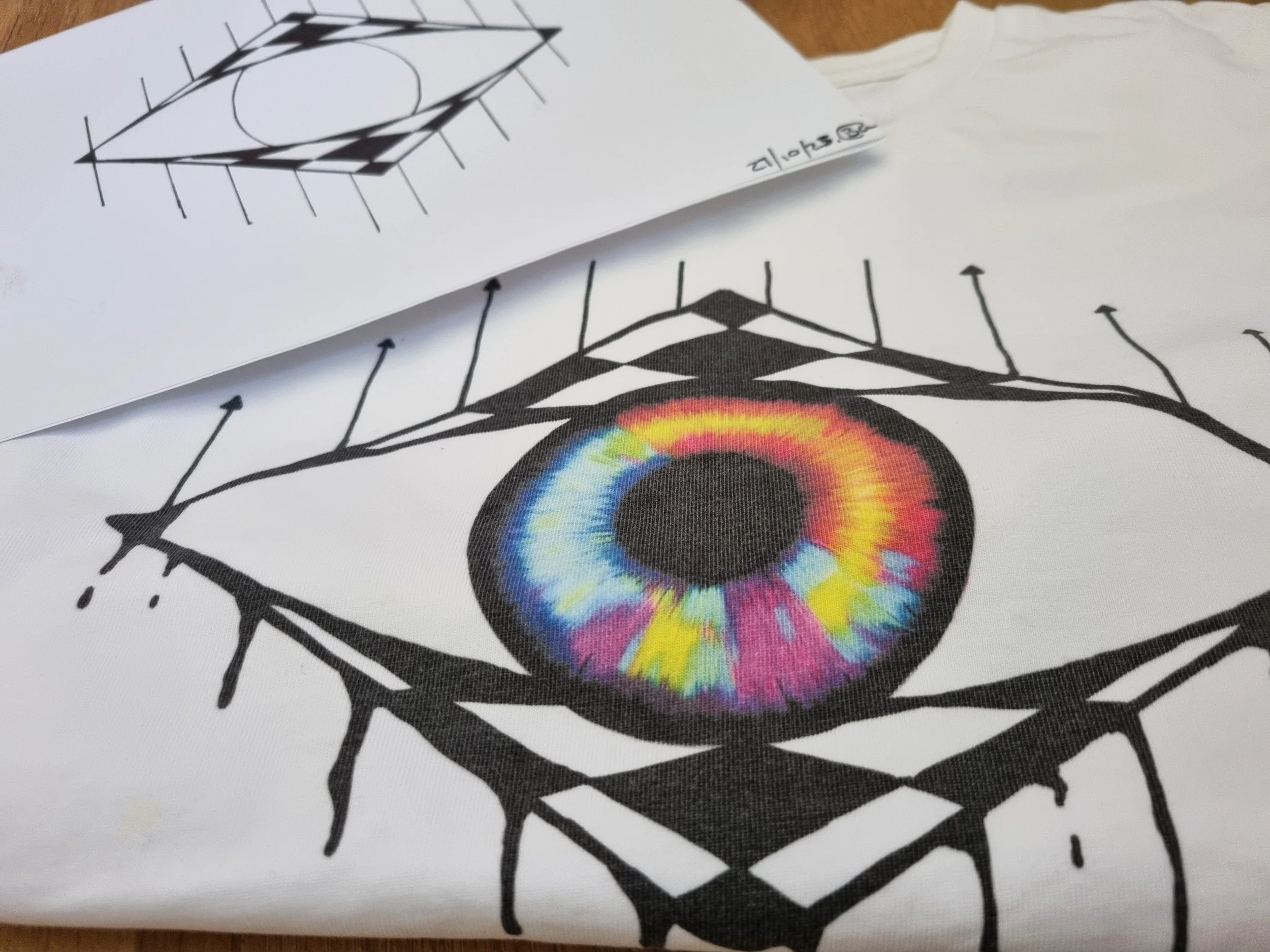
Ultraviolet Fractal

When I drew Ultraviolet in the early 2000s I was wrestling with the same questions I'm wrestling with now. The global issues haven't moved. Unless you count backwards as movement. This is the next chapter.

Model wearing Ultraviolet Fractal, for those unbroken

Model wearing Ultraviolet Fractal - Organic Streetwear for those unbroken.

When I drew Ultraviolet in the early 2000’s, I was wrestling with a lot of the same concerns as I am now. Not because my life hasn’t moved, it has, but the global issues I was thinking about at 17, haven’t.

Unless you count backwards as movement.

Creator or Destroyer

It’s about wrestling with the existential and where you place judgement. If you fix it here, does it break there? How do you know anything? How do you know what you don’t know? Are we creating or destroying? Earth or Purgatory? Are we alive or dead? That’s what I thought about at 17 – read into that what you will.

I’ve just finished Ultraviolet Fractal

The next chapter in the story. It’s the twenty year later version of the same questions. It’s the start of Ultraviolet as a character, and each new iteration, is an exploration of that story.  Organic streetwear for those unbroken. Still building, still trying, still fighting. Still figuring it out.

Read More

The draughty neck

Zip it all the way up and you've still got an inch of neck to the wind. A quick one about design shortcuts, zips that fail in month one, and what building for lifetime wear actually looks like from the inside.

Close up photo of a zip, showing macro detail of fabric density and zipper.

How many times can you zip before it fails?

I'm obsessing about necks. Hoodies specifically. It's still cold, summer is theoretical at best, and I've been staring at a zip that stops at the collarbone.

That's right. Zip it all the way up and you've still got an inch of neck to the wind. Design shortcut, plain and simple.

Zip’s that fail in month one

I've owned garments that are ancient. The zip still works perfectly. I've owned branded hoodies, and no-name, but branded hurts- selling you hype and tribe hoodies where the zip gave up before the first month was out.

It's easy to fake quality on the hanger. Before the third wash. Before the 50th zip. After that, you find out what you actually bought.

A zip upgrade adds cost per unit. A stitch density change adds cost per unit. These decisions get made, quietly, in favour of margin. The sale is what matters and it ends there.

I get it. Getting things made well is genuinely hard. The entire manufacturing industry is, from a structural perspective, substandard. That's not an excuse, it's the problem. It’s just how it’s done. This is changing, fast.

So, what do you do with that?
You research. Zips that don't fail exist- you’ll find them in mountain wear, for example. Who makes them, who tests them, are they compatible with the garments you're building.

And then you think about everything else. Colours that are kind to sweat. Care and repair. Spares for the parts that can't manage 25 years. A 14-year-old People Tree (RIP) sweater in my cupboard with fraying sleeves tells me organic cotton can go the distance; the rest is just decisions.

That's what building for lifetime wear actually looks like from the inside. Whether it’s zips or fasteners, plastic or metal, recyclable or not, all these designs effect the cost and profit outcomes, do I believe it is possible for Mongrel Logic to change the world in this regard? No, I’m not that naïve. But I am determined to try anyway. Now if you’ll excuse me, I need to go change my underpants.

Read More

What is Mongrel Logic

Mongrel Logic is me. A blog, two littermate puppies, a dog attack, and drawings I carried across continents for 20 years. This is how it started.

It’s been a little while since I have answered this question.
Mongrel Logic is me.

A flip on a negative

Macro image of the Pastel Eye design printed on black organic cotton.

A close up the Pastel Eye design.

I’m not an idiot when it comes to linguistics.  I am also not an idiot when it comes to emotions. I chose the name The Pavement Special originally, to name a thing that hadn’t been defined. That way I could write about whatever I wanted and in theory, the name could remain unchanged. I do enjoy business architecture.

I started a blog with no direction, zero SEO, literally a digitised dear diary. I needed a place to just write without thinking too much.

But, I spent 8 months not doing anything because I got two puppies. the month after starting it. Two. Littermates. If you know, you know. Turns out I am an idiot about some things.

One sunny afternoon we were coming off a dog walk, we were attacked by a bigger dog, who lives in our cul-de-sac, I might add. Everyone was physically ok. Lex has never been the same since. He thought the world was butterflies and sunshine before that moment. Zen is the more, suffer in silence, type. Just like me.

Rage fuelled caps

I was so angry about the dog off lead, the effect on the puppies, the effect on me, the fact that he made no adjustments and just kept walking the dog past our house, every day, three times a day. We had to make all the adjustments. I don’t blame the dog. Ever.

But a piece of my mind involves a piece of my fist due to the rage around this situation, so I decided to do something else instead.
Try to raise awareness, make a cap, donate profits to an organisation that cared about dog welfare and who can lobby. I have not forgotten about this. I never will.
And when it comes to animal welfare, the welfare of those less fortunate, you have found my hulk smash button. Now, I don’t have big fists, in fact when I look at a pinky-finger I am baffled that such a small bony thing can exist.  

I built a monster

I started working on the embroidery for the cap first, and I started looking at makers. Very soon discovered that my print on demand idea was not executable.  No custom fabrics. Hardly anyone did embroidery at that level.

I knew I needed to have the fabric made. I knew the cap construction needed to be custom, the embroidery needed an expert. I started hunting.  

This is where the designer range was born. Months of research, designing, and work and some number crunching, led to me to where I am now. I have spent nothing on this business; aside from running the websites, I don’t have anything to spend. As much as it is a practical reality for me, it is also part of a system I am testing. The reproducibility of the model. More on that later.

When I understood what I needed to get the cap made, the designer range off the ground, I knew I needed an engine. Something to fuel the designer range, that could stand on its own as well as exist as crossover, and crucially, matched the ethos of the luxury streetwear range I was developing.  I needed one project to fund the next one. Yes, fuck is right.

That’s when the art came into it, drawings that for some inexplicable reason I had held onto, taken across continents with me, suddenly had a purpose. The worlds I was building as a teenager, the stories, characters, novellas and the fifth try at starting a business and the second at a clothing line, suddenly all made sense.

That was the last time anything made sense. Haha.

Being responsible for the life cycle of your product is extremely important to me. I was born in Africa. I have lived equal numbers of years on both the African and European continents by now.  I know what it is like to be part of the problem and part of the solution.
I’m far from perfect, but I am so sick of the lazy, profit driven, greed led approach to business that I wanted to build something better.


Where regulations follow

You can call me naïve in 12-24 months, in the meantime, hold my beer. You may not be old enough to remember this, but products used to come with a lifetime guarantee. Microwaves, dishwashers, washing machines, fridges, all came with a guarantee. Not a warranty, a guarantee.  These days it’s hard to find anything that lasts more than 12 months. Organic cotton will still be in your wardrobe in a decade, just starting to fray.
When you design with the product’s entire life cycle in mind, you need to ensure you can answer for its journey once its owner is done with it, and it has to be made first from ingredients that allow it to be returned, remade.

Being early is only half the problem

I hope I get to bring my vision to life. I’m never convinced that it’ll work, but I am determined to try, because if it does, we are ahead of the regulations that will absolutely be brought in regarding product lifecycle.
When I chose Teemill, it was because they aligned on a design level.

When I ordered my first sample, I was honestly surprised at the quality. And the print colour was stunning. I knew I had found my engine. It’s been 7 months since I launched the shop, and it’s been 9 months since I came up with the idea for the cap. I feel like I’ve been working for four years.

The fact that I can’t spend on growth is agonising, but also crucial for the first 12 months. Which is kinda soul destroying in a way, being in this phase of the business, I have no idea what people think.  Releasing vintage, unchanged teenage art first, was the hardest test this little engine could pass. And we did.

Designing with constraint, whether that is showing art that was in skill unrefined, and not changing it, designing within our print box, no sleeves, no backs, no cuffs, no detail, has honestly allowed me to play in ways I never imagined with the designer range and prompted me to think about details I might have otherwise overlooked.

I can honestly say there is nothing like it out there. For both our everyday sustainable, circular streetwear range and our designer range. I’m not here to shit on other people’s designs, I love streetwear. Whether understated or street couture that serves one purpose and that is to photograph, I’ve been a lifelong fan. Are we the underdog? Absolutely, this was built for underdogs. Will you have seen anything like this before? No. Why? Cos I drew it when I was 14, 16, 17. Etc. And because I have been designing this range for a very long time.

Way before the dogs, before the blog, when I was still in primary school, scrap booking fabrics, dresses, cuts, colours.

This is Mongrel Logic.

Read More

Textile investigation

Exploring the tension between waterproofing and dye, from toxic coatings to Ventile cotton. A look at textile innovation and how Mongrel Logic approaches sustainable streetwear materials.

Olive oil on water

Olive and water - the design problem in one image

Not the sleuth, cat burglar kind of investigating. The kind where you realise you have been staring into a screen and not blinked for fifteen minutes. It’s also the term you land on when you were trying to think of something Inspector Gadget related and can only recall the rude versions.

Keeping you dry

Isn’t just challenging, it’s often toxic. Waterproofing is an active area of innovation and because of this, many brands that are in the business of keeping you dry have their own R&D, working on new materials, new methods. This is where textile innovation, waterproof fabrics, and sustainable streetwear start to collide.

Oil and water

I’m looking at this from the perspective of dye and print, and how textiles behave in real garments. Finding something that holds dye, specifically when it comes to translating artwork to garment, that is also waterproof, is a bit like oil and water. 

Enter the Manchester textile industry

I know, I know, cotton. Honestly, I keep coming back to it, regardless of where I go.  Ventile was developed by the Shirley Institute in Manchester, England. A dense, weatherproof cotton fabric that works without synthetic coatings. It’s a long story involving the need for a new type of flight suit for the RAF. But it resulted in PFAS free weatherproof material.

Materially aligned

I could list many more examples of innovative design like Colorifix, using engineered micro-organisms that create dyes, replacing what has traditionally been a heavy chemical process.  It’s fascinating, and it’s all feeding into the development of the designer range. Even if it makes ‘the’ list of what not to use. It’s already fed into our core range, and why we chose GOTS certified organic cotton. And it’s why we print the way we do.

Go-Go…textile innovation

I know I’m not making flight suits. Designing something that lasts, without relying on harmful materials or processes, is crucial. If you’re going to make it, how does it break down, how does it return, that is where this list becomes, shorter. For now.

Built through circular systems.
Shop the Core range.

Read More
Culture, Brand Story, Systems & Design Kerryn Hewitt Culture, Brand Story, Systems & Design Kerryn Hewitt

You've Been Sold Short

For a long time, streetwear meant hype or basics. Neither was built for you. Here's what better looks like.

For a long time, streetwear meant one of two things.
Hype. Or basics.

Either you were chasing a drop, refreshing a page at 8am for something you'd resell before you wore it, or you were buying a logo on a blank and calling it culture. Neither of those is fashion. Neither of those is art. And neither of them was built for you.

You were sold the idea that luxury lives behind a velvet rope. That it speaks a language you weren't born into. That it belongs to someone else, someone with the right postcode, the right accent, the right everything.

That was always a lie.

Mongrel Logic organic cotton streetwear, built for longevity, not trend cycles.

Mongrel Logic organic cotton

Luxury is construction

Fabric. Longevity. The feeling of putting something on and knowing immediately, this was made to last. Not made to trend. Not made to be binned in a season. Made to become part of how you move through the world. Streetwear at its best was always that.

The street has always been the catwalk

The difference is who's been building for it.

Mongrel Logic started from a simple dissatisfaction

With what exists, with what's accepted, with the gap between what people deserve and what they're being offered.

Artwork mapped onto garment

Fabric that reads like graffiti, like tattoos, like something with a past and a future. Not a clever play on words. Not a trend cycle mood board. Something that rewires how you think about what you put on your body.

Expect better. Wear better. Build better.

That's not a slogan. It's the only direction this was ever going.

Read More
Brand Story, Culture, Design Process Kerryn Hewitt Brand Story, Culture, Design Process Kerryn Hewitt

This One's For The Underdogs

Not the word. The actual thing. Mongrel Logic was built for the ones who were too loud, too quiet, too weird, too much, and still showed up.

Not the word. The actual thing, Mongrel Logic.
The kids who cleared hallways just by existing. The ones who were too loud, too quiet, too weird, too much, not enough. The ones who got their lunch money taken and their ideas ignored and still showed up the next day with something to prove.

Lex falling asleep while staring at his own reflection

Mongrel Logic, built for the underdogs. Lex the dog, brand mascot and co-founder.

That's who Mongrel Logic is for

Not because it's a good marketing angle. Because it's where this came from. I am the weirdo. The loner. The underdog mongrel who will not stop once it sets its mind on something. I built this because I had to and I built it for the people who understand that feeling without needing it explained.
Metal heads. Hip hop heads. Underground everything. People who'd like to see the world work better and have quietly stopped waiting for permission. People who don't need external validation and have learned to survive without it even when they do.

You don't wear Mongrel Logic to fit in

You wear it because you stopped trying to. The street is the catwalk. Always has been. We just build like we know it.

Read More

What it means to be early.

Being early in a space isn't a flex. It's a fact, and a bet. Here's what it means to build sustainable streetwear before the crowd arrives.

In a space that is arguably saturated, being early is a genuinely annoying problem to have. When I started this business, a single idea exploded into a full-blown world, system and vision.

One person. Infinite space.

Sustainable streetwear is born

There are people doing elements of what I'm building here, but not all of it together. And almost no one doing what I'm developing with the designer range. More on that soon.

Creating wearable art is the first expression of Mongrel Logic. I have never fit in boxes and I'm not about to start now. This is art for people like me, who listen to metal, hip-hop, Opera, acid jazz and R&B, who grew up on surf, skate and anarchy. Colour meets psychosis. But equally important is building something that endures, not just in the wardrobe, but in the world. Systems that are better than what exists today.  

Being early is not an ego statement

It's just a fact. We have a long way to go before fashion stops adding to the problem. I'm trying to do things better. Build better, last longer, endure.

Fashion should be heirlooms

Not landfill. I'm the first of a very particular kind of thing, bringing circularity to everyday wear, wearable art and mythology to streetwear, and a designer range built to last a lifetime.

That’s Mongrel Logic

For those who see it before the rest.

Read More

Growing pains.

A raw reflection on six months of building Mongrel Logic™ - sustainable streetwear, organic growth, and endurance in obscurity.

Short. Punchy. Honest.

Close-up macro photograph of a sewing needle threaded with red and yellow threads under tension against a black background

Close-up macro of a sewing needle with threads under tension.

I love building Mongrel Logic. We are officially into our 6th month as a start-up, on zero budget, that’s just a fact. Although, I look forward to it becoming a historical fact one day. Just saying, I still do the day job as well.

Time has lost all meaning.

Work never stops. There is no such thing as a day off. I’m not complaining, there are just many elements to what I am building. Organic business growth exclusively in our first year is just one of them, which is partly why time has lost all meaning.

Social media has taken over my life.

Days are spent agonising over content I have, knowing more needs to be done, having barely any time to do that, but needing to push on even if it’s not perfect. Even if I haven’t got everything I need. Which is an extremely frustrating problem to have, but essential at this point and an on-going process.

The reel story.

Sorry…The real story is I care about all this. I was born in Africa, I live in the UK. I’ve lived both sides of the solution and the problem. But this blog isn’t about waste. Nor about extremely good quality clothing for an exceptional price. (Shameless plug.)

I draw incredibly weird shit, mythical cosmic world builders, sun eaters, South African crime fighting superheroes, lots of eyeballs. It’s about using creativity to build a way forward. Said every artist ever.

I’m not afraid, to t…struggle in obscurity.

Persistence in the dark. Being unseen until the world is ready. The undertow, the liminality. A lone wolf. Gestating in the undercurrent of, ok, I’ll stop. World domination loading.

Endurance.

Not just a tag line. An essential ingredient to the first year, an ethos, a mindset, an inner vision and outward expression of what it means to live where design chaos and craft collide and what it means to think that survival deserves to be worn.

Read More

What does 340gsm mean?

What does 340gsm actually mean in a hoodie? We break down fabric weight, durability, and why heavier cotton matters if you want clothes that last.

Close-up macro of 340gsm organic cotton hoodie fabric showing dense weave and structure.

Close-up macro of 340gsm organic cotton hoodie fabric showing dense weave and structure, featuring Lilith’s Corsage.

GSM stands for grams per meter. It’s a measure of fabric weight.
The higher the number, the denser and heavier the fabric.

Is higher GSM better?

Not always. If you wore a 340gsm t-shirt in summer, you would melt.

Durability isn’t just about weight. It’s about construction, fibre quality, and how a garment is put together. But weight matters

Why 340gsm?

340gsm sits at the heavy end of everyday wear. It resists thinning at stress points, it holds its shape, it feels structured, it survives life and washing cycles.

Our 340gsm hoodies and sweaters are made from 50% recycled organic cotton and 50% organic cotton. Recycled cotton reduces waste input; organic cotton reduces chemical load.

Sustainability without durability is theatre.

Whether it’s a day-old button up that’s buttons have come off, or a sweater twists and thins and is unusable in 6 months, circularity doesn’t matter. Longevity comes first.

Why doesn’t everyone talk about gsm?

You don’t really need to. If something feels good enough, that’s usually enough. I care because everything in my cupboard that has been made with consideration, particularly organic cotton, I still have, so many decades later. A sweater that is as good now, as it was in 2012.

I want my clothes to live with me.

Like finding something at the back of a cupboard years later and it still feels epic.
We can do better than garments that fade or break after one wash.

It matters.

Read More
Builder, Design Process Kerryn Hewitt Builder, Design Process Kerryn Hewitt

The Story Behind Our Art: Building the Mongrel Logic™ Universe

Some of the artwork in our Core range was first drawn in the 90s. This is how old sketches evolve into sustainable streetwear and how the Mongrel Logic™ universe builds from the archive outward.

Close-up macro photograph of black embroidery stitched into heavy black cotton fabric, showing raised thread texture and dense weave detail.

Original lines, translated into thread. The archive, made tangible.

Mongrel Logic didn’t begin as a product line. It began with drawings.

Some of the artwork in our Core range was drawn in the 90’s and early 2000s. Long before hoodies and brands. In fact, what kicked this all off was drawing the embroidery for our Signature cap, more on that another day.

Flaws are as important as perfection.

Keeping the art close to its original form matters, not polishing away the awkwardness, not correcting every detail. Letting the lines stay human. Time will tell if the idea is sound or not. Re-working drawings without erasing where they came from, and building them a future, has been one of the most satisfying parts of all of this.

We are ‘the’ weirdos, mister.

I’m not apologising for it. Art has informed everything from the design of the first cap to the current development of the designer range. Testing art on textiles is the most fun I’ve had in years. Watching something once trapped in a notebook move into fabric feels like unlocking a small universe.

Art is the foundation. Form is the future.

Using my antique, vintage, almost cave-era drawings gives us a clear starting point. Not everyone understands the purple weird monster immediately, that’s fine. It’s supposed to be fun. It’s supposed to feel slightly unfamiliar. It isn’t made for everyone.

Serious comes next.

Right now, it lives simply. A sweater. A graphic. A familiar softness. I put on my own Logic Descends sweatshirt and feel the soft fabric settle. The drawing sits there quietly, carrying two decades of history with it.

This is how the universe builds.

From the archive outward. From the monsters under my bed, to the fabric you can’t say no to.

Read More
The Pavement Special, Growth, Process Kerryn Hewitt The Pavement Special, Growth, Process Kerryn Hewitt

Testing organic growth, not just organic cotton.

What does it mean to test organic growth properly? No shortcuts. No boosts. Starting from zero and building a sustainable streetwear system deliberately.

A Dirty hand shown gently nudging marbles into place on a rough asphalt road surface, close-up in daylight.

Close-up photograph of my dirt-covered hand placing small marbles on asphalt, symbolising starting from zero and organic growth.

Part of my early strategy is to test organic growth. Our small social accounts have only just found their full vocabulary, and testing has started.

Instagram stats are not a healthy place to live in.

Don’t get me wrong, it’s fun. I’m up for the challenge. But, playing a medium-to-long-term game while looking at daily stats is a bit like watching an hourglass fill, one grain of sand at a time. That part is dull as anything. Luckily, not tied to my personal sense of power or validation, but absolutely tied to planning and upcoming projects.

A Game of Follows.

Sorry…couldn’t help myself. Why am I being such a dick about doing it the hard way? Well, I can’t fully test the financial sustainability of the system without starting with zero.  It’s a lot to explain in a short blog, but part of what I am testing is the zero-start-up (or near zero, let’s face it) cost philosophy as well. But I did start the blog, before all of this was born, with nothing. Free documents, free versions, free everything.

How am I avoiding burnout?

I’ve planned. Most of the end of 2025 was spent documenting, taking pictures of our prints and garments in real life. I have endless content to use; the hard part is putting it together in a way that is legible.

I’m not so good with patience.

I wish there were another two of me. But we’d need to be able to tell each other apart so one of them is a cyclops and the other has snakes for hair. Read into that, what you will. I just mean sheer workload and ability to make time to be able to separate myself from it for long enough to have a good idea. That’s tough.

Speaking of good ideas.

I’m currently working on the latest design. I’ve been recording some of the process, not sure what I’ll share yet, but, fuck ja, if organic growth and slogging sounds familiar to you then join me why don’t you?  

Read More
Behind the Build, Brand Architecture Kerryn Hewitt Behind the Build, Brand Architecture Kerryn Hewitt

Why we’re building the engine before the designer range.

Why Mongrel Logic is building the engine before the designer range, proof before expression, growth without debt, and time as part of the design.

Abstract hand-drawn black hole sketch representing time, gravity, and systems pulling inward, an early visual study tied to the foundations of Mongrel Logic.

Abstract hand-drawn black hole sketch representing time, gravity, and systems pulling inward, an early visual study tied to the foundations of Mongrel Logic.

Every brand would love to start with the hero product, the piece that looks like the brand. We do too, but for us that’s the destination, not the starting point.

This isn’t just about organic cotton.

It’s about organic growth. Everything you see here has been built without investors, without paid promotion and without shortcuts. Not because those things are inherently wrong, but because designing out waste is the backbone of how this business works. Including financial waste.

Proof of concept before expression.

Building the engine first has allowed us to test out the logic of the system early. Not just sustainability, but design language, production decisions and how the work is received. It’s also how early signals are built.
It’s a way to learn without burning capital, and to refine without panic. This is how the Designer range gets funded without debt, without rushed decisions, and without compromising the thing its meant to be.

Starting at the “wrong” end.

Most brands build authorship and architecture after they launch, often because the first product has been funded. As it stands today, this little business has no debt, and that’s an intentional constraint. It means doing things in a different order. At times the harder order.

Mongrel Logic.

There’s a reason this business is called Mongrel Logic. I am Mongrel Logic.
It’s frustrating to work with systems that reward speed over thought.  But it’s also incredibly effective at testing whether something can hold its shape.

Time is part of the design.

Time.
And we’re right back to the first blog and where this all started. Time to build the engine. Time to see what holds. Time.
The designer range is coming. Not as a gamble, but the next logical phase.

On a personal note. I’m not good at time. I’d rather walk than wait to catch the bus. I’ll get there faster.  

Read More
The Pavement Special Kerryn Hewitt The Pavement Special Kerryn Hewitt

A Carnival of Creation.

There is something freeing about being this early. No one’s watching. Nothing breaks. A studio note on creation, mistakes, and learning what to remove.

Black and white photo of a studio desk with notebook, keyboard, and Mongrel Logic website open on screen.

Black and white photo of the studio desk.

This is what this has felt like.
In a good way…And now I have Dimmu Borgir stuck in my head.

Acrobatics aside…

(Carnival.) I forgot to put worms out for the birds. Ah well, tomorrow.
There is something freeing about being this early. No one’s watching, really. Which makes developing clarity a lot more fun because there is zero external pressure. Nothing breaks, you know?

That doesn’t mean that fuck-ups are never a threat.

I have sat here till 2am fixing errors, only to notice at 11am, that 2am is no time to bloody fix errors. But it does mean that it’s basically me, the dogs and the cat that know about it. Phew.

There is no time like now.

Most of the time now is spent removing, not adding. Which is strangely much harder to do. In practical terms. Less is more but knowing which less is less is much harder to do.

Circus Tent is up.

Oops swapped continents. But it’s fully erect. (Clears throat.)

Bally, bally, bally.

All this circus talk. Step right up. What’s inside?

Read More
The Pavement Special, Mongrel Studio Kerryn Hewitt The Pavement Special, Mongrel Studio Kerryn Hewitt

Designing for Endurance.

Endurance isn’t a look. It’s a commitment. Designing for endurance means building under real constraints, material, human, economic and refusing to pass the cost on to someone else.

Timeless used to be a look that stood the test of time. A quality piece that survived seasons because it outlived its moment. That definition no longer holds.
The quality no longer holds, and the silhouette has gone from timeless to time stamped.

Endurance is practical, not poetic.

Founder working at desk

Founder working at desk

Designing for endurance begins when you accept reality as the client. Use, time, money, labour and consequence. It shows up in stitching that doesn’t come undone, zips that don’t fail. And it extends beyond the object to the grower, picker, maker; if you’re forced to undercut yourself to remain viable, that fragility is built into the product from the start. Calling something sustainable doesn’t correct that. Paying properly does.

Endurance forces business change.

Most design avoids endurance because it forces long term thinking and costs short term gains. Designing for endurance means not offloading these questions onto the customer. It means building systems through aftercare, design and partnership, where responsibility remains with the maker. Where products can be returned, reused, recycled or passed on without becoming someone else’s problem. Where a product can become an heirloom rather than landfill.  This way of working doesn’t fit neatly into traditional business expectations. It doesn't align well (yet) with shareholder pressure or growth that depends on constant replacement. That friction isn’t accidental, it’s the point.

Endurance changes the customer relationship.

Not through constant novelty, but through trust. Inviting return not just to buy but to see what has been built next.  Through meaning, innovation, and designs that aren’t shaped by hype but instead carry weight, story, ethos and credibility. Ultimately, it’s about responsibility. About refusing artificial exclusivity. And not treating the customer like a cash cow or dishonouring their custom.

Endurance is non-negotiable.

Designing for endurance is not a claim of purity or perfection. It’s a commitment to build under real constraints, economic, material, human and to redefine those choices and the consequences. Redesigning them so there is meaning and reward instead. Selling products that aren’t a lie. That thinking is already being tested in what we’re building now, under real constraints.

Read More

Sustainable Streetwear Isn’t a Trend; It’s a Systems Problem.

Sustainability isn’t failing because people don’t care.
It’s failing because responsibility has been pushed to the weakest part of the system. This is a systems problem, not a trend problem.

a black and white shot of a desk, showing notebook, laptop, pen holder.

Systems don’t change themselves.

Sustainability is being treated as a consumer responsibility instead of a system responsibility.

We’ve outsourced accountability downward, to customers, to workers, to suppliers, while profit stays safely at the top. It’s infuriating. And it’s everywhere.

Sustainability talk is booming while quality collapses.

Choice is increasing. Longevity is not. You don’t need to be a designer to notice it. Groceries shrink. Clothes thin. Products fail faster. That contradiction isn’t accidental, it’s engineered. And it shouldn’t be acceptable.

We are not at the end of a solution. We’re at the start of a very long curve.

Sustainability fails the moment it asks the weakest part of the chain to carry the most responsibility.

Fast platforms. Endless drops. “Capsule wardrobe essentials” released weekly. Externalised costs dressed up as innovation. Profit-first systems with zero consideration for product lifecycles, and even less for people.

This is why Mongrel Logic exists as an outlier.

When I first sketched the Designer range, the goal wasn’t to make a cap. It was to make something that lasts a lifetime, with a traceable lifecycle and no future landfill. Not just something you wear, but something that rewires how you think about what you wear. That thinking is already being tested quietly in what we’re building now.

True sustainability isn’t boring.

Yes, it can be slow. Yes, it can be unsexy. It involves trade-offs. It involves constraints. It involves admitting what you don’t control.

But working inside limits isn’t a compromise, it’s a test. A test of whether new ways of thinking, working, and creating are possible without pushing profit upwards and damage cascading down.

Most systems won’t even try. I will.

Read More

Baaplrvlsrsppdtedpdspot.

A month of studio work doesn’t always have a name. This is an attempt to give one to everything that happens before a launch feels real.

Founder at desk drawing Lilith's Corsage

Founder (me) drawing the latest design, Lilith’s Corsage

I know it’s not a word, but it’s the best one I have for everything I have been doing over the past month. Brand architecture and authorship, practice-led research, visual language systems, reflective studio practice, platform dynamics, threshold and entry design, process documentation, and sustaining practice over time.

Which all sounds very fancy for a fuck-ton of work.

And it has been. But every month that goes by, I refine this little system and fine tune it and it’s really starting to look like what I had in my head. It’s been hugely frustrating at times. Some research is still going nowhere due to the nature of what I am trying to build, I am early. Being early means I need to define, not copy. And do it in a way that I can stand by proudly. When you are the first to do a few things, there is no one else to ask.

Which is equally Great! And terrifying.

Luckily, I am that busy I don’t have a lot of time to think about the terrifying and just focus on the next thing, and the thing after that. It sounds cryptic, and it’s not meant to. Inside my little brain is everything that we are about to launch next. We have three upcoming projects, one of which is the designer range.
All the designs, web development, copy writing, trademarks, legal, fulfilment, packaging, that list above, are all juggling for top spot. I can only pick one thing at a time.
Not to mention Insta, which for the first time is starting to feel like a thing. I can’t tell you how much work has gone into that, far too many 2am finishes.

A strong finish to 2025.

We got our first orders through and our first reviews, I’m living in a world of firsts now. It’s quite fun. And we’re off to a hell of a start for 2026, having ironed out my Baaplrvlsrsppdtedpdspot.

What’s coming in 2026?

This year I’m planning to launch the designer range, where this all started, with Mongrel’s first design, before any of this was a thing, our signature cap. A cap isn’t really a winter thing. I have another two big projects lined up for the next month to three that are in the wider Mongrel universe but not linked to the designer range, more on that later.

Deep breathe and plunge.

As I stand here, right on the edge of the precipice, it’s a very cool place to pause. From this vantage point I can look back and still see everything I have built, to get me where I am now. And I am about to jump off the proverbial cliff (suited up) where I will lose this perspective and gain a new one. I can see everything laid out in front of me, or the possibility of it, and the hard solid ground behind me. It’s still quite peaceful, despite the noise in my head. All of that is about to change.

Read More

A Christmas Of Refinement.

I now find myself waking in the night with tension from holding down Ctrl +C and not pasting it, because technically, I’m asleep.

Lilith's Corsage in progress

Lilith’s Corsage in progress

Much to the annoyance of everyone around me, the amount of work I have been doing to build this little engine that could, has kept me up so late that I almost saw Santa.

Have you ever dreamed in ctrl c, ctrl v?

Neither had I, until I started building the shop. I now find myself waking in the night with tension from holding down Ctrl +C and not pasting it, because technically, I’m asleep. This should give you some indication of how many alt texts, descriptions, documents, versions, oh my!

The little engine that could.

Four days of drawing later, our latest design, Lilith’s Corsage, is now on the website. I wanted to do a lily, but not floral in the traditional sense. I pulled elements from older drawings and folded them into the piece; that’s where the checkerboard petals come from, for example.

I guess now the test of the dream begins.

Not the ctrl copy and paste dream. The whole thing. I’ve tried breaking it, and it stands. And now I’m about to roll the proverbial boulder down the hill.

Too many metaphors?

This is the first chance I’ve had to flex in two weeks of product design, store development, and endless strategy work. So yes, too many metaphors. My brain is trying to wake up after long hours of repetitive tasks. It’s not quite there yet.

A refined store front and some new pyjamas.

That’s really…a wonderful thing.

Read More
Mongrel Studio, The Pavement Special, Builder Kerryn Hewitt Mongrel Studio, The Pavement Special, Builder Kerryn Hewitt

Verbal bondage and visual systems.

Naming the work while building it: three characters, a new visual system, and the first time the whole thing can breathe.

The three characters of Mongrel Logic, generated an AI image to help think about the language. Shows the Builder, the Engine and the Designer. Reflecting the Build, the Circular range and the Designer range.

AI visual showing the three characters to Mongrel Logic, a small part of the process of developing our visual system.

The tiny problem when you build like I do is the language evolution as I progress. I’ve changed the website more than I have changed outfits this year.

Defining what hasn’t been defined.

Learning how to talk about the three characters I inhabit in this world has been extremely challenging. Every time I refine even the smallest phrase, the knock-on effect of clarity in one area means a complete rewrite in another.

It’s ok, I won in the end.

I have emerged from the wilderness of my own mind, covered in moss, dirt and ichor. But I think I might have finally moulded all these things into one coherent, cohesive story that finally has its visual shit together.

The evidence of our evolution is here for all to see.

I don’t mind that. At all, actually. I have built this from scratch. Whether it’s finding identity in wording, or arguing with myself over flat felled seems and GSM, pattern makers, choosing our manufacturers for the limited editions; it’s been one hell of a journey to be able to stand here next to a thing that looks like a thing. The beginnings of a thing. A ‘th’ if you will.

Mongrel Logic has found its stride.

Which is good because I walk fast. I have not stopped in months. The tiniest bit of wording on the website, image, description, product seen and the coming soon limited-edition range is all occupying my head. All trying to find its mark.

It took a minute, but this is the first time it’s felt like it can breathe.

There is much more coming. And so much more to do. I’ve just finalised a visual identity system. And our next hoodie design is under construction. I’ve just finished rewriting the website again, and for the first time, I think I have a plan for our socials. The AI image above was part of that journey, trying to articulate the three characters of my business. I needed a visual way to help me delineate language and this helped quite a bit.

Read More
Studio Updates, Behind the Build Kerryn Hewitt Studio Updates, Behind the Build Kerryn Hewitt

Mongrel Logic is 2 months old!

Mongrel Logic just turned two months old. From rebuilding the shop to launching our first designs, it’s been wild, painful, brilliant and we’re only getting started.

A AI generated image of a cupcake featuring the Mongrel Logic Logo and in the same colour gradient. I simply can't bake that well.

Mongrel Logic Cupcake with Logo icing (not its not real, how else do you give a website and a brand a cake?)

I’m not going to lie, that was painful. It was fun, but also painful. I have built a shop, rebuilt a website, more times than I can remember, our designs are rolling. Fixed embarrassing errors, all of them, I hope.

We’ve got new designs coming

I’m working on our next design as, well…not as I type that would make me an octopus. But now. Currently.

Now it’s time to spread our wings

It’s been a massive amount of work to get here. I’ve been up till ungodly hours sorting out everything from marketing strategies to future Core Range designs and our Limited-Edition range.

It’s all been worth it.

I started the blog two years ago with no direction and just waffled on for over a year before I developed any of this. I have some loyal bloody crew that have watched me do this from the start and talk about everything from cutting down trees to the thing that sparked the cap idea. I’ve built this in public, which we will continue to do. I started with nothing, I started before the idea, and here we are.

Excited for 2026

There is a lot in store for 2026, we have artists we will feature, we have the designer range, launching next year and will continue to grow our circular, sustainable, deliciously soft organic cotton designs, bringing you circular, wearable art that’s been built to endure.


Subscribe to The Studio Dispatch for more.

That’s our newsletter.

A AI generated image of a cupcake featuring the first design. I simply can't bake that well.

It was hard to stop, this digital cupcake features our first design. I’m hungry now.

Read More

A Quick Note on Our Studio Hum

“We adjusted it, shaped it, sped it slightly, and paired it with a bark that sounded exactly like Zen; turning a simple sample into the signature Mongrel Logic™ sound.”

DJ at work, moody photo showing hands and decks

DJ at work

Since changing all my social profiles to business accounts, I can no longer post my videos to my favourite songs, boo! And no disrespect, but it’s hard to find something royalty free that is incredible.

I became an overnight sound designer.

Which was a lot of fun. Finding sounds, editing them, finding samples playing around with layering; weird, random sounds coming out the office. The problem is, it’s very time consuming. And I am all about time saving. So, I made a sound. We have an official sound. My days of sound designing are over.
Our base layer came from a Sample Focus clip called “Gospel Choir Hum” by user2866535286451.
We adjusted it, shaped it, sped it slightly, and paired it with a bark that sounded exactly like Zen; turning a simple sample into the signature Mongrel Logic™ sound.

The shortest career ever

Well, it was fun while it lasted. But I can’t tell you how relieved I am to just be focused on visual content again. It’s cut my content creation time in half. And I’m rather proud of it. Woof.

Read More