

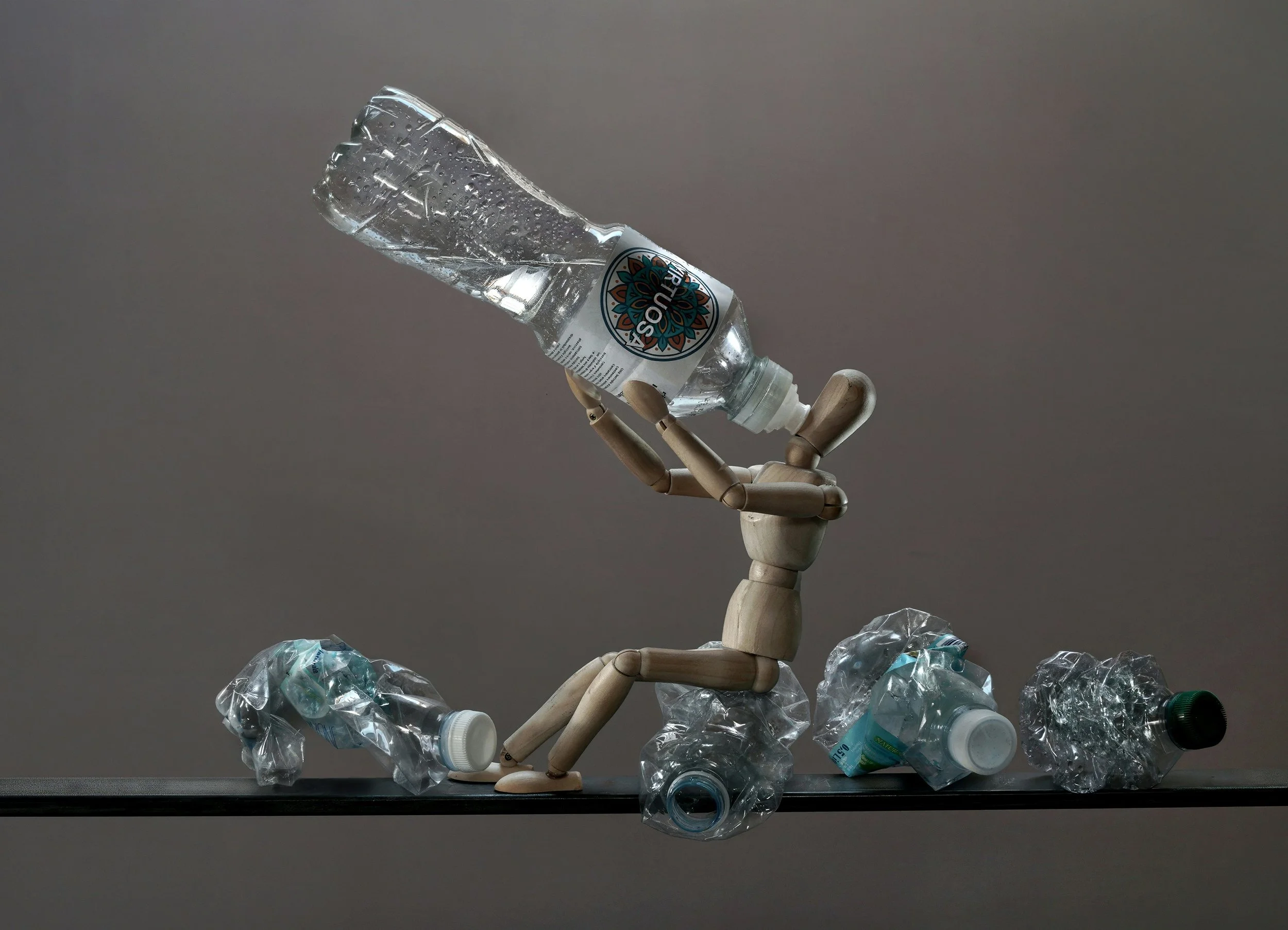
Is AI sustainable?
Does an AI prompt really use a bottle of water? We look at where the claim came from, newer data on AI water and energy use, and why better environmental reporting matters.
A line often quoted is that an AI prompt uses a bottle of water. This stems from a 2023 paper that estimated training GPT3 in Microsoft US data centres could evaporate 700,000 litres of freshwater. The same paper projected global AI-related water withdrawal could reach approximately 4.2–6.6 billion cubic metres by 2027.
In 2025 Google reported that its median Gemini text prompt model used approximately 0.24 Wh electricity, 0.03 g CO₂e and 0.26 mL direct cooling water. A later independent academic analysis expanded Google's accounting boundary to include estimated water consumed in electricity generation, raising the estimate from 0.26 mL to approximately 0.725 mL per median prompt.
Google compares the electricity used by its median prompt, 0.24 Wh, to less than nine seconds of television.
So, there is your bottle of water. But, is it the same bottle of water we started with?
How thirsty is AI? It depends on what, and how, you measure.
Can you avoid AI?
No, and yes-ish.
You can absolutely choose not to use generative-AI tools, but AI is increasingly embedded in other digital services.
For example in banking, email, games, phones, computers, security and many of the other digital services we use.
What does this have to do with streetwear?
It’s a question of sustainability. And reporting. AI is now firmly embedded across industries; fashion is no exception. From fake prom dresses to game-changing 3D design software, to the changing way we shop.
Sustainability, transparency and reporting are currently changing across the fashion industry. The EU, UK and other jurisdictions are developing and introducing measures aimed at greater environmental and supply-chain transparency.
Sustainability has been at the core of everything I have built from the start. There are gaps in our current AI environmental impact measuring, reporting and transparency. Until those are ironed out, we don’t have a clear picture.
While this isn't currently a requirement, and may never be, our global sustainable journey is trying to start, albeit through smoke and fire. Understanding the impact of what we do is as big a part of that as anything.
Is using AI sustainable or environmentally harmful?
If electricity per prompt is the metric we're using, Google's comparison puts it at less than nine seconds of TV. But electricity isn't the only metric.
Using AI can look about as environmentally dramatic as watching a few seconds of TV. Change the metric, and the picture changes.
AI is not going away
I hope we see none of the adverse AI futures we have been warned about. I fear we’ll see at least some of them. I'm not convinced that everyone in power has a vested interest in outcomes beyond their own. I'm not an optimist.
I, perhaps foolishly, hope that AI can help fix some of our biggest problems.
Until then, we need better data than water bottles and seconds of TV.
Sources
Li et al. (2023). “Making AI Less ‘Thirsty’: Uncovering and Addressing the Secret Water Footprint of AI Models”
Google (2025). “Measuring the environmental impact of AI inference”
“The Hidden Thirst of AI: A Framework for Estimating Direct, Indirect, and Scarcity-Adjusted Freshwater Consumption per LLM Query” (2026)
How I Designed a Game Around Streetwear
I started with a T-shirt design and no real plan. Somewhere along the way it became a world, a card game and a comic and an alternate reality streetwear game. Here’s how I built a game around streetwear.
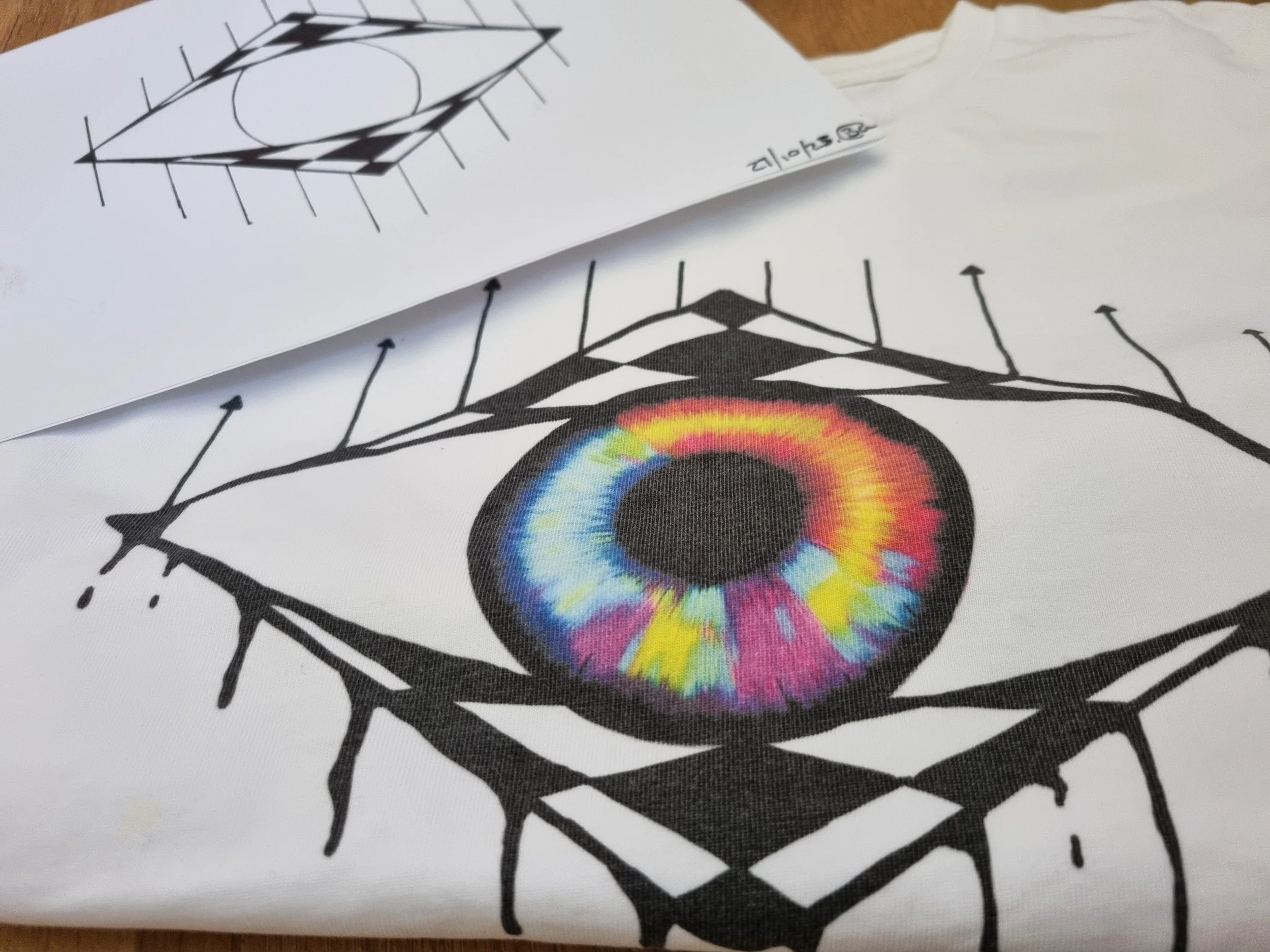
Geometric Eye was the first design that I drew for the Teemill store. I had no idea what kind of store I was building, other than sustainable. I knew I wanted it to be different.
At that stage I was cycling between everything from 90s retro symbols to geometric animals with no decisions. I knew I wanted to use my old art.
The first design, the geometric eye sketch and printed version.
Redesigning 20yr old characters
I took some of my old characters, drawings and sketches and put them in the store. I didn’t have a reason why. Some I redesigned slightly, and some I kept the same.
These became Logic, Tenet, Ultraviolet and Sun Eater.
Gradually, as I added more art, illegible to all but to me, the world was emerging.
Their stories were unfolding.
The characters were evolving and before I knew it I had a psychostasia judge, a slightly too experimental planet builder, an intergalactic backpacker who stopped by for the music and bubble wrap and an intergalactic star maggot who is happily munching on dying stars.
Unfortunately, that last one is heading toward ours.
Mapping game to garment
That was really the easy part. I researched different ways games communicate rules, worlds, progression, player behaviour, consequence and more, across wildly different games and media, and then figured out what my existing world could mechanically do.
What happened to sustainability?
I leaned heavily into sustainability messaging those first few months and discovered then that sustainability on its own wasn’t going to move the needle. I had to make it worthwhile. Mean something.
One of the biggest things we do is circularity. And it’s one of the last things we do as people.
So I built recycling into the game twice. In play, Recycle undoes your opponent's last move. Outside the game, the same idea continues through the clothes: scan the QR code in the care label, return the garment when you're finished with it, and it goes back into the system to become something else.
I’m not claiming I’ve solved the problem, but I am trying to make participation part of the thing.
Alternate Reality Streetwear Game
The clothes are the artifacts. The cards are where you play. The comics are where the characters come alive.
Different parts of the same world.
Game to garment
The cards and the artifacts (clothing) are now coherent. The final designs are being added over the next few weeks.
Next, I'll be finishing the cards and working on getting them into the hands of our testers.
If you would like to test the game, you can find out more here.
Playtesting An Original Card Game
What does it take to playtest an original card game? As The Canis moves from simulation testing to physical prototypes, the next challenge is finding the people willing to play it, break it and tell us what doesn't work.
The past couple of weeks has been an all-out sprint to get the game completed and simulation tested. I’ve started art, though I wish I had a clone I could force to draw for eight hours while I work on everything from socials to funding.
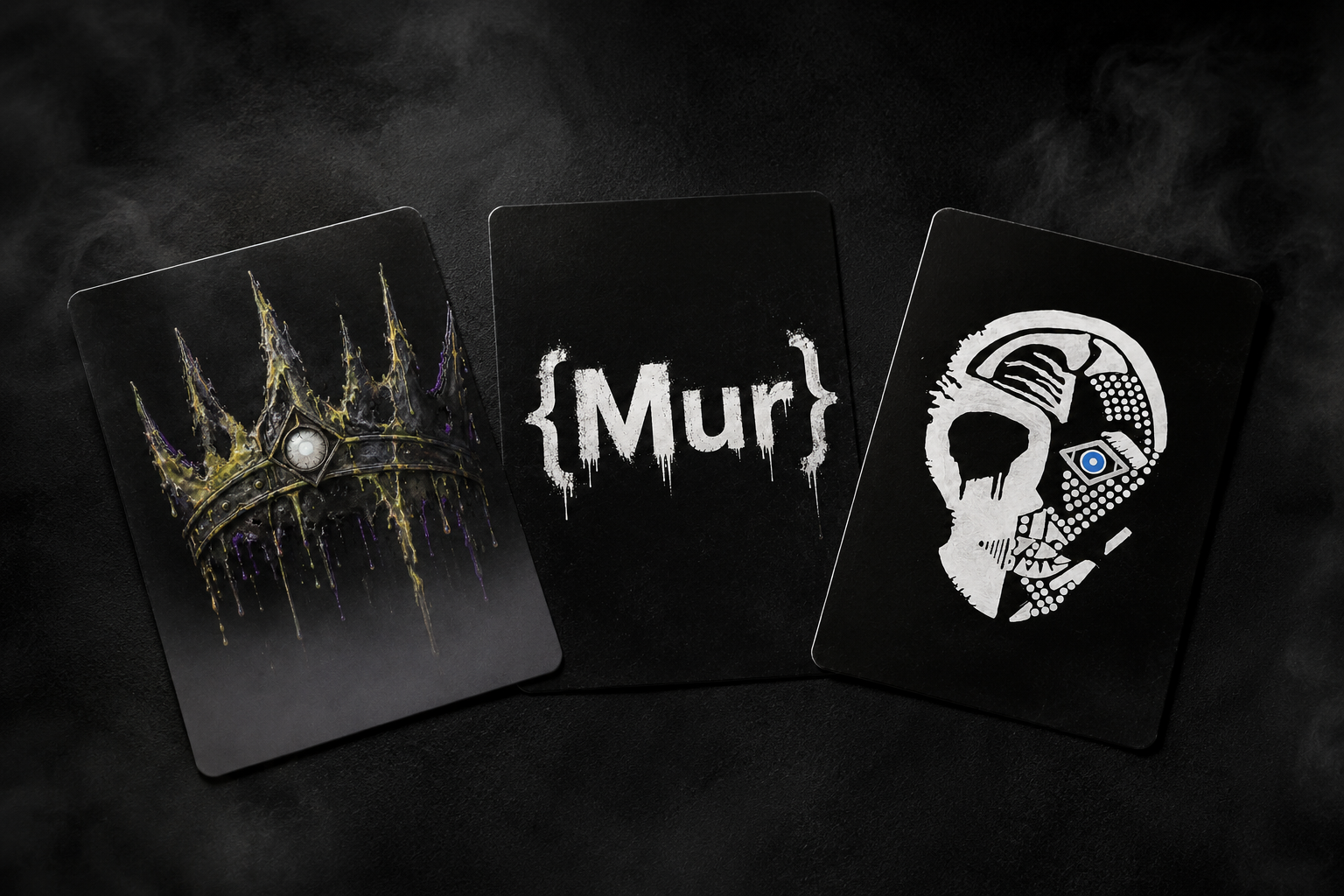
The Canis card game is moving from simulation to physical playtesting. Prototype decks are coming.
Finding your people
Mongrel Logic has always been for people like me. Who can just as easily be found listening to metal as they can opera. Who love science and science fiction, who love words, worlds and fantasy. The more blurred the genre, the better. Intelligent topics but not to the exclusion of “Destination F****d.”
People who love fashion as much as they do cosplay and make-up and the holey sweatshirt they have lived in for the past twenty years. People who care about what is going on in the world, would quite like to, you know... well, you know. But we're also determined to see it fixed.
We don’t really fit in the boxes. We exist across genres, places, cultures.
How do you find playtesters?
Ideally, you find your people.
Well, that strategy is unfolding. In all the areas hinted at above.
What do the playtesters do?
We're selecting a small group to receive a prototype deck and booklet before launch.
Play it. Break it. Tell us what doesn't work.
Selected testers will receive a Mongrel Logic organic cotton T-shirt as thanks.
When is this happening?
Over the coming weeks, as I complete the artwork, I’m selecting a small group of people to playtest the first Canis card game before launch. Register your interest in playtesting if you’d like to be a part of this.
I still need to name the card game. The Canis blank as it stands. Might just be the card game, spade a spade.