


The Ecodesign Regulation
The EU's Ecodesign Regulation marks a major shift towards circular products. As Digital Product Passports begin rolling out, here's why they matter for fashion, transparency and the future of sustainable design.
The Ecodesign Regulation is an EU framework designed to improve the sustainability and circularity of products throughout their lifecycle.
This week marked an important milestone. The Digital Product Passport infrastructure went live, with textiles identified as one of the EU's priority sectors.
Fashion is no longer later. It’s happening.
We built for this
It’s always been a priority for me to build something that was sustainable.
Our fabrics are made from 100% GOTS certified organic cotton. Our factories are powered by renewable energy.
Our dyeing process alone, is worth reading about, all garments are dyed in a closed loop system where water comes out clean enough to drink.
Using low-waste digital printing technology and water-based inks that conform to GOTS and Soil Association organic criteria is crucial to circularity. Our inks contain no animal-derived products and are not tested on animals.
And we print on demand, reducing overproduction.

Organic cotton garments awaiting production. Building sustainability begins long before the first print is applied.
Why DPP?
Looking at textiles, most people don't know much beyond what's printed on the care label.
There is no dye information, which is traditionally toxic and uses and wastes a lot of water.
No manufacturing information, where was it made, does the product contain restricted chemicals?
Yes, these can be found in clothing.
There is no recycling or repair information.
And nothing about how much carbon was produced when making it.
Up till now all that has been required are garment care labels. Wash cold, no tumble dry, fire warnings.
It’s the beginning of the end for greenwashing. “Made sustainably” is no longer going to cut it.
People, Product, Profit
This is how it should be.
We’re nowhere near, sadly. But these regulations walk us toward a circular future where ending fashion waste is an outcome.
It’s not just textiles, steel, batteries and iron are in the priority groups. If you’ve been reading this blog from the start, you’ll know Ive been bitching about low quality products built to last a year for as long as I’ve been building.
We are a long way from the kind of future I would love to see, where every product has been designed for its entire life cycle. This is where it starts.
What happens next?
Testing.
Phased rollout.
At the time of writing, the DPP regulations have only impacted very large producers.
Large producers are now prohibited from destroying their unsold textiles and footwear.
Early days
As with all new regulations, there will probably be challenges along the way.
Like what to do with the 30% of clothing that doesn’t get sold.
You can see the changes already, a large fashion retailer here in the UK has been advertising the same green dress for the past two months. Now it’s all about re-wear, reuse, recycle.
When I started Mongrel Logic, I wasn't trying to follow regulation. I was trying to build a better way of making products. Seeing circularity become part of legislation feels like confirmation that the industry is finally moving in the right direction.
We're still at the beginning. But for the first time in a long time, it feels like fashion is being asked to think beyond the point of sale.
The Problem With Circularity
Circularity sounds simple until you look closer. Textile waste, fast fashion, affordability and regulation are all pulling in different directions. Nobody has solved this yet.
We produce 92 million tonnes of textile waste globally per year, with projections rising further by 2030.
Circular fashion has a long way to go.
Voluntary schemes like Remill, has recovered over 100 tons of clothing in the first two years of opening the scheme to all brands.
This is why we don’t have a branded logo tag. So that you can recycle your tee or hoodie.
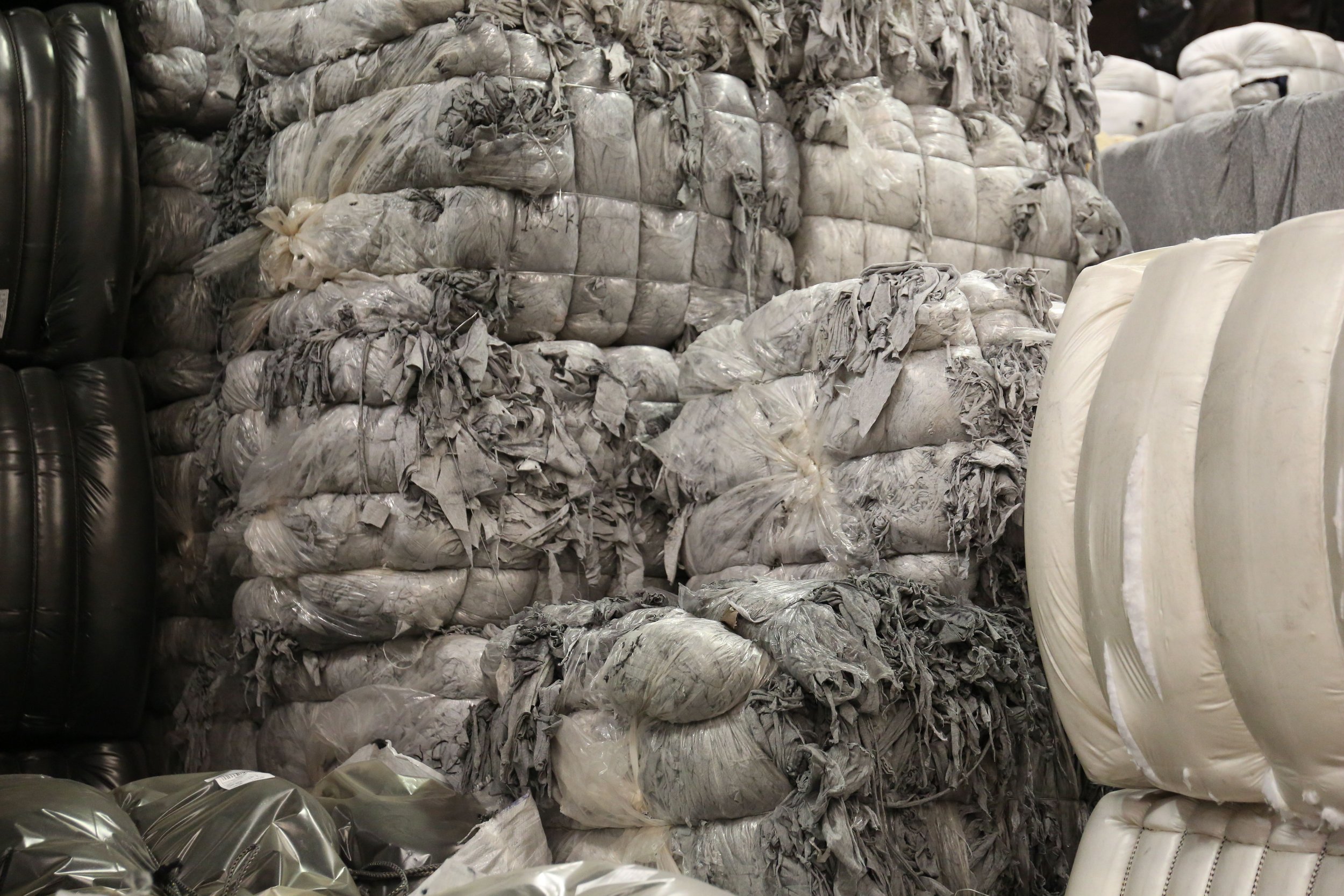
This is what recycled fashion looks like. Recovered, prepared for remanufacturing.
Asking people to change behaviour
I don’t think this is impossible, we do it all the time. Asking businesses to change, that’s another thing altogether.
Some fast-fashion retailers (you know who) add thousands of new products every day.
Which has been designed for speed, scale and profit rather than longevity, repairability or what happens once it's out in the world.
With fast fashion being increasingly the affordable choice, this is only going to get worse.
Poverty and Sustainability are linked
This is a tough one.
People living with fewer resources are often forced into behaviours that look sustainable from the outside. Having fewer options available isn’t the same thing as sustainability.
Being able to make ‘conscious choices’ is a privilege.
It shouldn’t have to be.
Does building circularity into a streetwear ARG help?
I don’t know yet. Is it going to help solve the worlds problems, probably not.
I’m bothered when business push recycling issues downstream, but in this case, downstream is where the t-shirt is.
People do need to be more invested in what they buy, how often they buy, which brands they support.
I don't know how you resolve these two conflicts.
Will change be regulated?
Many countries are developing textile waste regulations, but much of the sector still relies on voluntary participation.
Regulations are coming, but slowly.
How can a game fix this?
Well, that remains to be seen.
But if we are going to ask people to participate, then surely, we need to build something better. Not more expensive. Just with more meaning.
Not saying I’ve solved that.
Cash for recycled bottles (and t-shirts😉) aside.
Which I’m down for. But, we need so much more. Nobody has solved this yet.
I’m trying.

You've Been Sold Short
For a long time, streetwear meant hype or basics. Neither was built for you. Here's what better looks like.
For a long time, streetwear meant one of two things.
Hype. Or basics.
Either you were chasing a drop, refreshing a page at 8am for something you'd resell before you wore it, or you were buying a logo on a blank and calling it culture. Neither of those is fashion. Neither of those is art. And neither of them was built for you.
You were sold the idea that luxury lives behind a velvet rope. That it speaks a language you weren't born into. That it belongs to someone else, someone with the right postcode, the right accent, the right everything.
That was always a lie.
Mongrel Logic organic cotton
Luxury is construction
Fabric. Longevity. The feeling of putting something on and knowing immediately, this was made to last. Not made to trend. Not made to be binned in a season. Made to become part of how you move through the world. Streetwear at its best was always that.
The street has always been the catwalk
The difference is who's been building for it.
Mongrel Logic started from a simple dissatisfaction
With what exists, with what's accepted, with the gap between what people deserve and what they're being offered.
Artwork mapped onto garment
Fabric that reads like graffiti, like tattoos, like something with a past and a future. Not a clever play on words. Not a trend cycle mood board. Something that rewires how you think about what you put on your body.
Expect better. Wear better. Build better.
That's not a slogan. It's the only direction this was ever going.